Vampires At The Table
My Take On Gaming The Undead

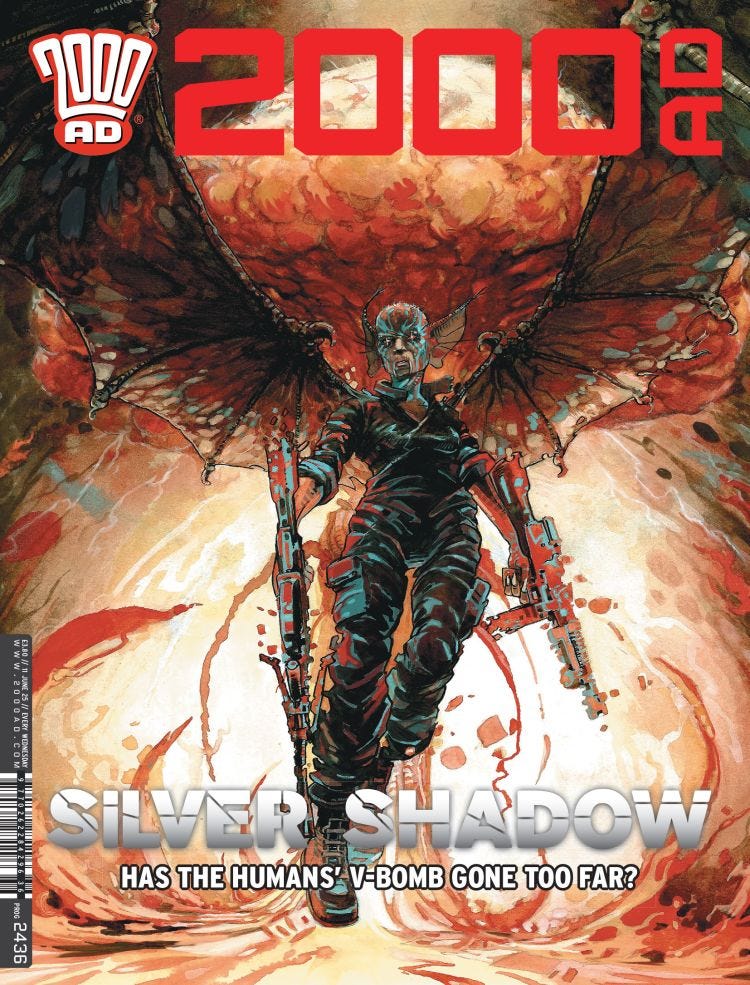
The above image comes from 2000 AD, the British comic, and depicts Silver, aka the Baroness Yelena DaSilva, a vampire of some 500 years young brought out of her long torpor and recruited by the humans of an alien-infested Earth.
It’s Vampires Versus Aliens, not to put too fine a point on it.
Also, Baroness DaSilva reminds me sometimes of someone I used to know, who once worked with the Tax Office.
She never had much of a sense of humour, either.
The person I used to know, that is.
Which brings me to this week’s topic - the Undead.
Everybody knows vampires aren’t real. Not, at least, in this world. But the worlds of fiction are alive with them.
Well, not alive as such. Just not … non-existent.
The worlds of fiction include the worlds of tabletop roleplaying. You may, by now, understand that tabletop RPGs are a large part of my life.
Not so much the sitting down with fat, sweaty men fighting endless combat simulations. More the narrative style, where the vampires confront what it is that make them inhuman, and embrace the qualities which make them more like the humans they used to be.
Cue this book cover.
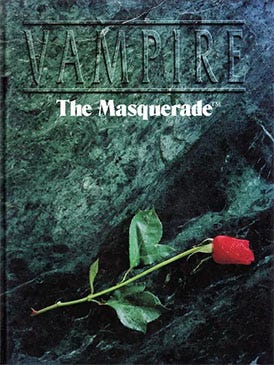
This book turned a lot of heads 35 years ago, back in 1991. It eclipsed a game called Ravenloft which had human D&D characters fighting vampires, and replaced them with vampire player characters.
You know what was big at that time? Anne Rice’s Interview With A Vampire. That book, and its two sequels, rocked the book world, and spawned so many copycat series, from the writings of Poppy Z Brite with its explicitly-gay themes to Laurell K Hamilton with its ultimate degeneration into BDSM porn.
Stephanie Meyer’s execrable Twilight series would come much, much later. But 1991 was a turning point for gaming and literary fiction, because that was the year that vampires came out of the casket.
Vampire: the Masquerade made it cool once again to be a Goth, and to embrace the whole vampire aesthetic.
It’s time to look at what it is that makes vampires in literature, and other forms of entertainment, so compelling. Let’s look at some of the themes explored.
Eternal Existence
What would it be like to be alive forever, of a sort? Vampire gaming allows you, the player, to experience a state in which death itself is but transitory; temporary. Vampires face the death of their mortal bodies and, somehow, come back … but changed.
If you had the choice, to not make death permanent, would you take it?
Forever Young
Next to eternal existence is the prospect of being eternally young and, of course, beautiful. How you are on death is how you will be, for centuries. Vampires would put the entire cosmetics industry into the history books. If they existed for real, millions would flock to their havens, desperate for one long kiss.
Preternatural Cool
The third thing to come out of vampire literature is the desire to be cool, and never to find oneself going out of fashion somehow. This was the theme of The Vampire Lestat by Anne Rice. In order to stave off decades of ennui, Lestat had to reinvent himself. He became a rock god, and drew fans from all four corners of the globe.
The All-Night Society
Then there’s the appeal of belonging to a shadowy upper crust of elite beings, lurking among the highest echelons of mortal humans, looking down even on CEOs and Presidents and kings because your undead status gives you so much time to plan your rise to power, compared to the mayfly mortals.
The cruellest, most ruthless human crime boss would bow the knee to the canny vampire with access to resources the humans couldn’t begin to imagine.
Downsides
Of course, there would be downsides to vampire existence …
Eternal Hunger
Like an addiction you cannot shake, your unlife would be centred around human blood, and human life force. A parasitical hunger which consumes, basically symbolising the human drive to gain position at other people’s expense.
Which sounds like crime. Which it could be.
Violation
This one’s a huge red flag. Vampires violate people. They drain them dry, kill them, and then the dead humans come back as more vampires.
Even the taking of blood, breath, life force is not something many humans willingly would allow or consent to.
Vampire feeding is a brutal assault, with sexual overtones lending it to be closer to actual sexual assault in some cases. Hunting without a sexual element is not much better, if the vampire drains too much of the humans’ life force, causing them to sustain life-changing injuries. But the West seems to okay brutality, preferring to hear stories about harrowing injuries rather than about consensual sex.
The Predator Class
The Undead represent, symbolise, the very worst elements of human society. A small group of elites, accountable to no-one but themselves, living life on the blood of millions of people, facing no real consequences for their actions … yeah, we can see what vampires symbolise in this world.
Apotropaics
Vampires in fiction are supposed to be susceptible to certain banes. Needing to sleep in a coffin containing soil from one’s grave; vulnerability to sunlight, garlic and holy water; casting no reflections in the mirror; beheading and staking being really deadly … all these weaknesses come from folklore.
People needed to invent these “cures” for vampirism, and made them popular in fiction, just to give people a feeling of ease if they’d just read of some horrid vampire terrorising some city like Dracula, or a family like Carmilla Karnstein. Like the invention of Kryptonite, the public needed to know that something could stop the otherwise-unstoppable superbeing in the pages of the shocking books they read.
They needed assurance that the monster who came down from the Schloss on the hill at night could, in fact, be stopped, or at least held accountable.
Inescapable Subtext
The vampire story has a subtext, made manifest any time your vampire character comes across as queer-coded. Look at the Poppy Z Brite depictions of vampires, or J Sheridan LeFanu’s Carmilla, or the way Bram Stoker’s Dracula groomed Jonathan Harker while showing off his bisexuality by attacking Lucy Westenra.
Despite their best efforts, Lucy becomes a vampire, and preys on the streets. The parallel with straight fears that people can become LGBTQIA+ is obvious. This part of the story appealed to the irrational hatred of Victorian homophobes. Being gay was illegal back then, and everyone was talking about it, especially since queer people could just walk among the ordinary folks - and straights were in the dark, then as now, as to who was not straight and how they could identify one another.
People back then had a morbid fear of being queer. It terrified them, more than being fed upon. More than turning up naked in a public setting.
Vampires symbolised queer identity, moreso back then as today, What We Do In The Shadows notwithstanding. Vampirism was the fundamental fear that the readers’ latent LGBTQIA+ identity would be found out by the public, and subject to the oppropbrium reserved for witches, mutants, and neurodivergent people.
If they didn’t understand it, they condemned it. And to be honest, the Victorians really didn’t understand much. At all.
At the last minute, a friend of mine reminded me to point out that all of the above applies to women. The horrors of the female lived experience in the nineteenth century and the first seven decades of the twentieth century cannot, and should not, be ignored or dismissed. In fact, women are struggling even more in this third decade of the 21st century, with their rights being eroded by the day, and even straight cis women spearheading the organised drive to push women back into the kitchen and bedroom, with a gag in their mouths.
Transphobia is just the fruiting body of this mycelium.
Loving The Vampire
Vampires are one of three undead species occupying niches within human lore. The other two are zombies and ghosts.
Each type of deathless being brings their own stories to the gaming table, as well as popular fiction. Ghosts (from phantoms to revenants) represent a drive to come back to finish something left incomplete; zombies just represent the Western drive for mass consumption at all cost; and vampires represent the predatory urge to feed on humans, use them, and drain them dry.
Vampires represent the most human of the Undead. They walk among humans, enjoy the same things we do such as art and music, and can pass for human (a topic which hits home, considering the title of my blog). That makes vampires incredibly alluring, attractive, and absolutely, devastatingly, sexy, both for what they represent and for the potential benefits of existence.
They walk among us. But they are not aliens, in the sense of being extraterrestrial. They are young, and ancient, and everything in between. They are cold, and cruel, and make you want them so much.
They make you want to be them.
Imagine if they were real; and books like the one below were more than simple entertainment.