
The Door Into Winter
Writing While The Storm Rages

I’m writing this on a dreary, rainy day. The sky outside looks miserable, and the rain is pounding against the glass.
There’s an episode of Star Trek: Enterprise on the TV. “The Catwalk.” In this episode, the crew are forced into a sort of storm shelter for a couple of days to ride out a massive space storm.
The episode, and the storm outside, remind me of one of my favourite themes - the storm shelter, where the protagonists are forced together into a tiny, cramped, confined space to weather inclement conditions.
Stories like these are the perfect opportunity to explore how individual characters cope, or fail to cope, with the stresses of facing an unavoidable dangerous situation. Some characters fret and hang around the airlocks a little too much for comfort. Some just freak out and need to be calmed, or put in their place by the Captain - who, truth be told, feels the stresses more than the rest of the crew combined. And some wrap up warm, curl up in their bunk and get some sleep.
I used to run science fiction tabletop roleplaying games. I’m tempted to write fiction based on Berin Kinsman’s Starlight Opera science fiction, but I’d rather write up an M-Space story, featuring ships designed by Traveller’s High Guard ship design system, perhaps subbing M-Space’s Spaces for Traveller’s displacement tons or dtons.
My favourite Traveller ships are the 50-dton modular cutters, the Space: 1999 Eagles of Traveller. Cutters are all shaped like cigar tubes, with a 30-dton cutout in the middle for a hot-swappable module. Modules can be designed to serve a bunch of functions: mass passenger transit, long-term habitation, survey, lab space, stables, and even mobile modules to provide lavatories and bathrooms for open air festival attendees.
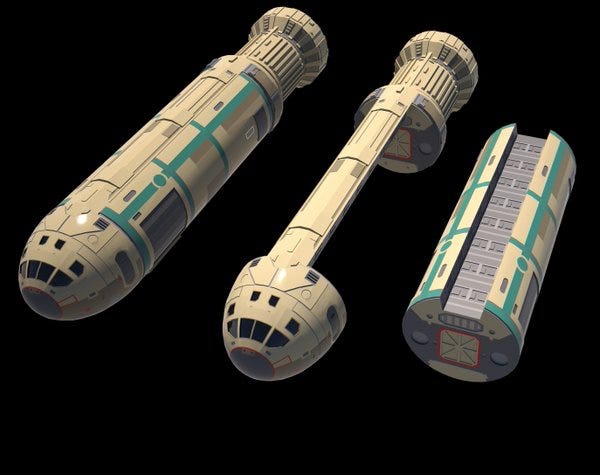
One design feature I always include in any of my HG ship designs is to allow a modular cutter to act as a kind of storm shelter, particularly in a larger ship (400 dtons or greater, designed to house a modular cutter and a couple of space modules).
Ships can be designed with radiation shielding, as can modular cutters and, independently, the modules themselves. There’s nothing that says they cannot stow a cutter away in its hangar, with its bridge systems tied in to the main ship’s bridge, allowing the ship to be piloted remotely from within the modular cutter, which would offer reduced facilities for the crew.
If the ship has multiple such boats, the cutters could be put together in the hangar, their airlocks linked to facilitate movement between them, and the ship run from the bridge of the master module.
Meantime, the crew would be safe in the admittedly-cramped quarters, cheek to jowl, eating rations, learning to adopt nesting behaviour until the ship can make it to the safe harbour of the destination planet’s magnetosphere.
In the midst of a universe full of all that empty space, it’s ironic that we would have to stay physically as close as possible to one another to survive. Perhaps this says more about us than we would care to admit.