
RPGaDay 2023, Day 24
Final Straight ...

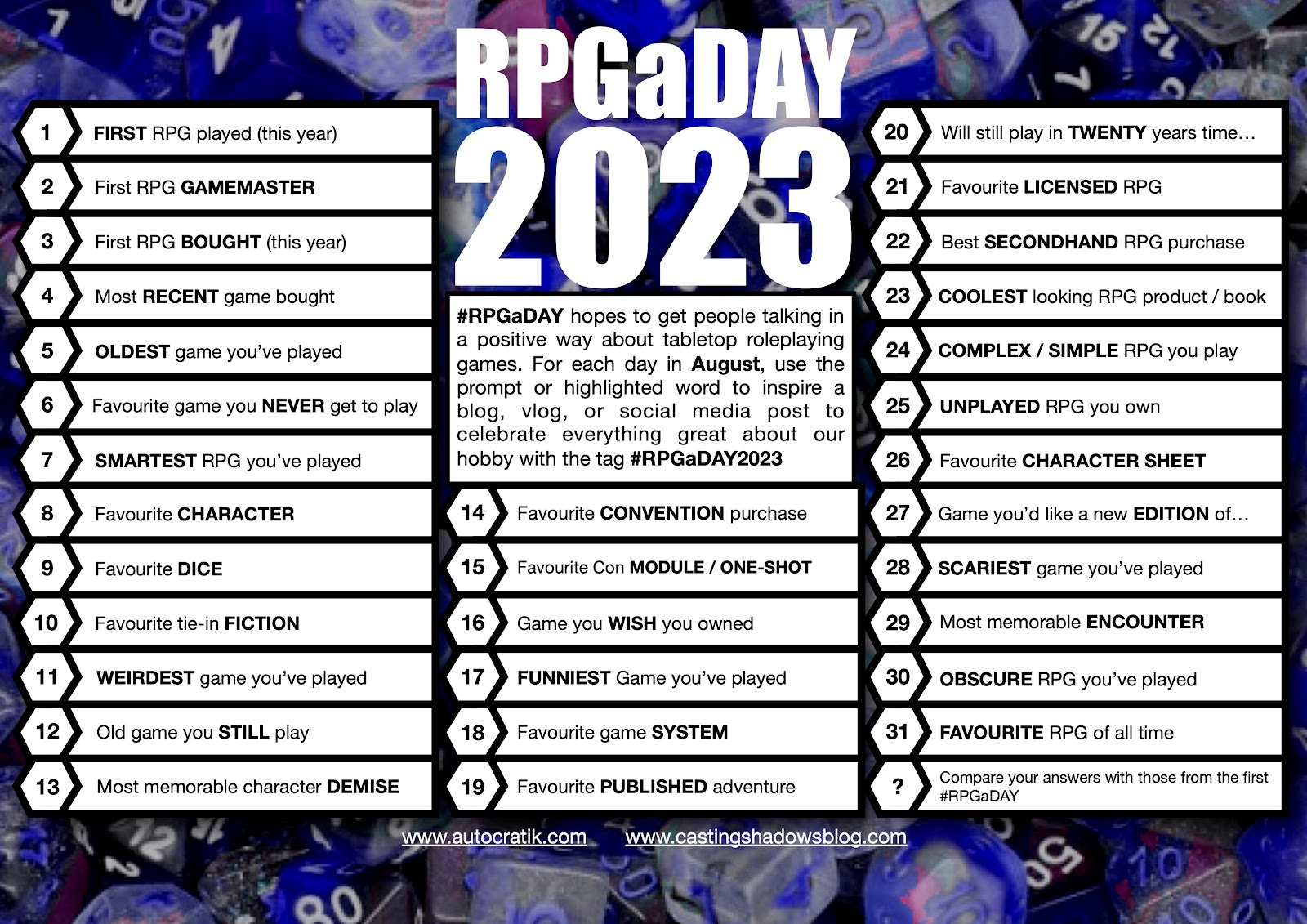
At this point, there’s just a week to go till the final RPGaDay update.
Complex RPG versus a simple RPG. Looks like we’re given a false choice. One or t’other.
The thing about a complex game is that sometimes, they present complexity to you and call it “richness” and “depth.” The problem is, a complex system is hard to play. And perhaps what you were looking for is a complex setting.
A great example os Onyx Path’s Geist: The Sin-Eaters.
The setting is the World of Darkness. Your protagonists are people who died, and who entered a Bargain with a being called a Geist over in the Underworld. Geists are beings invented for the World of Darkness. They are neither ghosts nor spirits, but something else. What they are, it turns out, is Reapers - like the Grim Reaper of mediaeval legend. Death beings. If you’re familiar with the manga Deathnote, they are what the Japanese would call shinigami.
Sounds simple enough. Your protagonists come back from the dead with a connection to death itself - death, the underworld, and the paths and portals connecting the worlds of the living and the dead.
And then you get the rules. Rules for forming Krewes. Incomprehensible magical systems, systems for Geists, for Reapers, for ghosts. Terms like Burdens, Remembrance, Synergy, Esotery. Then there are their powers, called Haunts. Numbers, numbers, numbers.
It’s not the only complex game going. Changeling: the Lost has its own magical powers, called Contracts. These aren’t spells = they are more like legal documents signed with goblins, which allow the Changeling character to make changes to the world.
And then there’s the Mage Sight rules from Mage: the Awakening, which are way too complex. Passive Mage Sight, Active Mage Sight, Focused Mage Sight, versus Opacity, a Trait of Mysteries which is reduced one point at a time, but beware - too much scrutiny risks unleashing some sort of backlash?
Complicated. Too much information. Too many variables to look after.
Another example is Modiphius’ Star Trek Adventures, which is aesthetically execrable. I can’t even begin to get into the rules, because the pages are unreadable.
So let’s have a look at a simple game. Comae Engine from Frostbyte Books looks like one of the simplest game systems I ever saw.
This is character generation.
Characters in Comae Engine consist of four main components:
»» Skills. Nine broad skills define what knowledge a character possesses, often connected to a career. Range: 0-100%
»» Conflict Pools. Four Conflict Pools show how much damage and stress the character can take. Range: 1-20 points.
»» Tags. Tags represent any advantages the character has picked up, like wealth or a secret identity. Represented by a few words.
»» Luck Points. Luck Points make sure fate stays on the character’s side – as it should for heroes. Range 1-3 points.
There may be more to it, and the extra bits are introduced in the book, but in essence your character can be generated in a few minutes, and play is simple.
I want to run a Comae Engine Modern game, set in the world of 2023. The setting would be something like Den & Lauren, The Chaotician, or Taken Under.
I’d also like to create my own fantasy setting for a system like Traveller, or Cepheus Engine, or create one that’s entirely system-agnostic, meaning that everybody can have a go at playing in that setting with whatever game engine they want to bring to the table. It’s an approach which works for Columbia Games’ / Kelestia Publications’ Harnworld, and it works for me.
Because it isn’t about the system you use. It’s the setting. You should never confuse a complex game engine with a complex game setting. If you make your setting a compelling one, you can get away with writing a complex setting and still sell the readers a dirt-simple game engine. People will flock to your game, just to play in the setting, and never mind the engine.